Surgery, Gastroenterology and Oncology

|
|
“A good surgeon knows anatomy; a great surgeon respects it.”
(Attributed to Sir Astley Cooper, British surgeon and anatomist)
Every December, the pink city of Jaipur, the touristic capital city of the state of Rajasthan in west India eagerly awaits one of its most anticipated academic events—the Jaipur Surgical Festival (JSF). Conceived in 2021 (by VKK), JSF has steadily evolved into a globally recognized academic platform. The Festival is organized annually by the Mahatma Gandhi Medical College and Hospital (MGMCH), a constituent unit of the Mahatma Gandhi University of Medical Sciences and Technology (MGUMST), Jaipur under the auspices of the International Association of Surgeons, Gastroenterologists, and Oncologists (IASGO).
The 5th edition of JSF, with the Theme of Surgical, Radiological and Endoscopic Anatomy, was successfully held from 4th to 6th December 2025. The central theme for the 5th JSF 2025— “Evidence-Based Medicine vs Anatomy-Based Surgery”—struck at the very heart of surgical practice.
“Surgery is anatomy, anatomy, and anatomy.”
Joseph E. Murray (1919–2012), the Nobel Prize winning surgeon and pioneer of organ transplantation, repeatedly emphasized, in his lectures and interviews, that mastery of anatomy is the foundation of all surgery. A surgeon’s preparation mirrors that of a pilot before a flight - systematic, meticulous, and unforgiving of error. While a good surgeon rehearses the procedural steps, a great surgeon revisits the anatomical details that will unfold within the operative field. A single misjudgement or error can plunge the patient into irreversible harm.
The life of a medical student begins in quiet bewilderment - trying to unravel how delicate layers of peritoneum drape and embrace the viscera. With time, study, and countless dissections, that complexity is distilled into a single, assured utterance - “Scalpel please.” The passage between these two moments is a long apprenticeship with anatomy, marked by repetition, reverence, and the gradual transformation of the uncertainty into a surgical intent.
5th JSF 2025 brought together eminent surgeons from across the globe to deliberate on anatomical checkpoints, recognize variations, and share refined strategies for navigating complex dissections. Open and engaging discussions explored anatomical challenges in gastrointestinal, hepato-pancreato-biliary, hernia, thyroid, and breast surgeries. The overarching objective was clear: to transform surgery into a deliberate, safe, and life-saving art, and to remind every surgeon that “incision, dissection, and repair without anatomy is akin to a blind man carving wood.”
The Festival was conducted in a hybrid format this year—faculty members were physically present on-site in Jaipur, while delegates attended online. This model ensured efficient organization, reduced logistical demands and costs, precise time management, and minimal audience-related disruptions. Importantly, it enabled a far wider global reach.
5th JSF 2025 recorded about 300 online registrations, including approximately 200 delegates from India and 100 international participants. Registrations were completed in advance via Google Forms. A nominal registration fee of INR 500 (less than US$ 10) was charged from the Indian delegates mainly to discourage non-serious participation, while delegates from other countries were offered free (complimentary) registration. Participants joined from an impressive range of countries, including Cambodia, Cameroon, China, Ethiopia, Hungary, Indonesia, Ireland, Kenya, Kyrgyzstan, Malaysia, Maldives, Myanmar, Nepal, Pakistan, Peru, Qatar, Senegal, South Africa, Sri Lanka, and Tanzania.
The faculty was drawn from several teaching institutions and corporate hospitals from all over the country. Despite widespread domestic flight disruptions because of an airline mismanagement, there were zero faculty cancellations—a testament to the commitment of the speakers. Eight faculty members who were unable to travel because of these flight disruptions delivered their sessions online without compromising the academic rigor of the JSF.
Day One: Foundations and Flow
The academic proceedings commenced on 4th December, under warm winter sunshine tempered by cool breezes. The welcome address was delivered by VK Kapoor, Professor of Surgical Gastroenterology at MGMCH and Pro Vice-Chancellor of MGUMST, followed by an address (online) by Dan G Duda, Secretary General, IASGO (USA). The JSF Oration was delivered by RA Sastry, an eminent GI & HPB surgeon from the Krishna Institute of Medical Sciences (KIMS), Hyderabad who eloquently addressed the fundamental question: “How and why is anatomy indispensable to surgeons?”; he was also honoured with the JSF Sammaan (Sanskrit: sammaan = honor) 2025.
The first day featured intellectually stimulating sessions on the surgical anatomy of the esophagus, gastric conduits, cardiomyotomy, and gastrectomy in the forenoon. Afternoon sessions explored the intricate anatomy of the colon and rectum, including nuanced discussions on the “bends,” “lengths,” and “not-too-much lengths” of the Roux limb. Early evening sessions addressed two highly anticipated topics—the urinary tract anatomy in colorectal surgery and the female genital tract anatomy in rectal surgery.
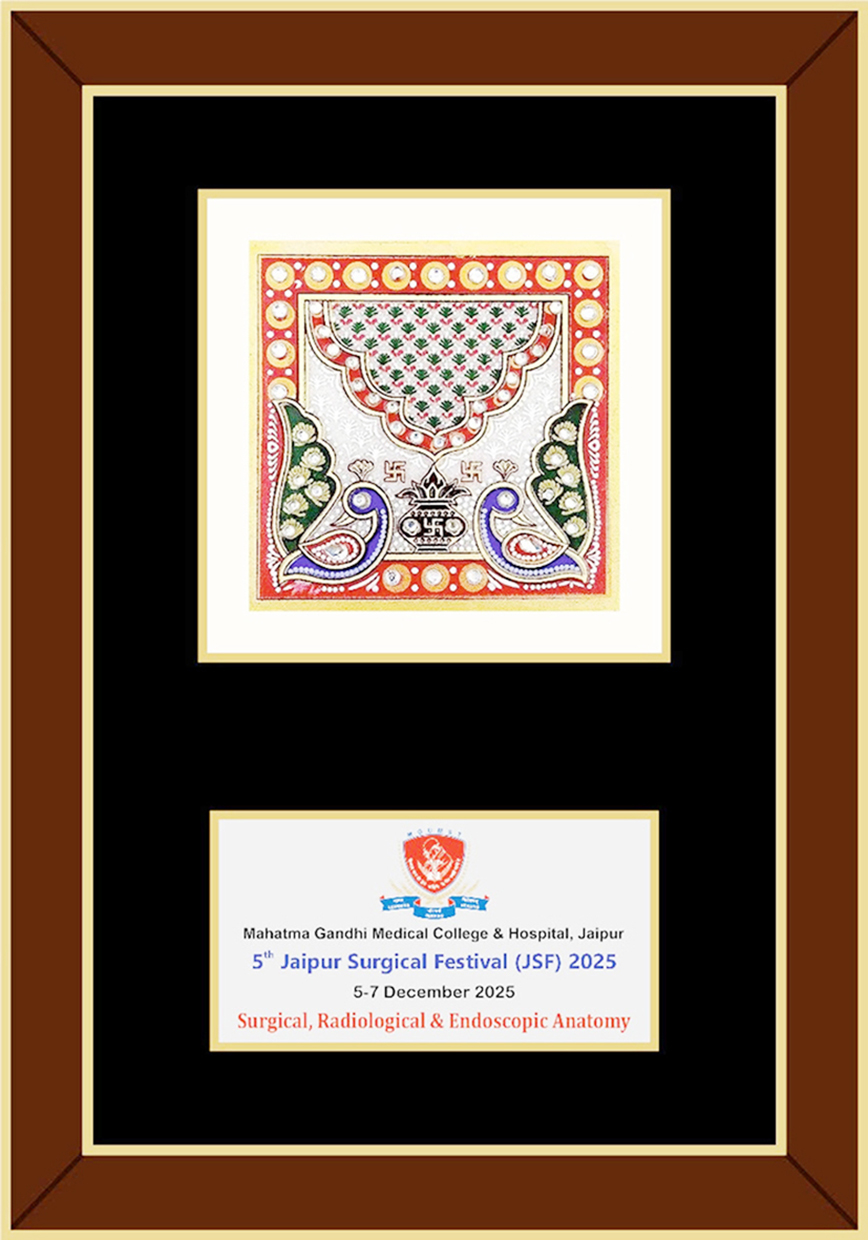
The day concluded with a grand gala dinner, graciously hosted by Vikas C Swarankar, the Chancellor-cum-Chairperson of MGUMST, fostering informal yet illuminating exchanges among the faculty. All faculty members received a framed Rajasthani stonework as the 5th JSF memento (fig. 1).
Figure 1 - 5th JSF 2025 memento - framed Rajasthani stone work
Day Two: Depth, Detail and Dialogue
The second day began with eagerly awaited sessions on liver anatomy, addressing radiological correlations, segmental anatomy, venous drainage, and arterial variations - presented with remarkable clarity by the respective speakers. This was followed by engaging sessions on pancreatic vascular variations, pancreatic head resections, and distal pancreatectomy.
Post-lunch sessions focused on gall bladder anatomy, emphasizing the critical view of safety and structured dissection. Detailed discussions on bile duct anatomy, danger zones, and prevention of bile duct injuries - especially in difficult cholecystectomies - were particularly impactful. Special attention was paid to the blood supply of the bile ducts, underlining its importance in preventing ischemic strictures. Advanced sessions on porto-systemic shunts followed, culminating in a comparative analysis of wedge versus segmental liver resection in extended (radical) cholecystectomy for gall bladder cancer, addressing oncological adequacy and technical precision.
Day Three: Consolidation and Contemporary Practice
The third day focused on essential components of general surgery. Sessions on laparotomy and abdominal closure revisited evidence-based practices to minimize wound complications. These were followed by comprehensive discussions on incisional and groin hernia repair, comparing laparoscopic and open approaches with respect to patient selection and outcomes. The academic programme concluded with focused sessions on breast and axillary surgery, thyroid surgery, and reconstructive flaps, offering practical insights into anatomical safety, oncological principles, and reconstructive strategies.
A hallmark of 5th JSF 2025 was the unhurried, meaningful discussions after each session. Questions and comments were never rushed, creating a relaxed academic environment in which speakers often remarked that they “learnt as much as they taught.”
Two defining features distinguished the 5th JSF 2025. First, impeccable time management - not a single session exceeded its allotted schedule by more than 10 minutes. This was ensured by a few medical students aspiring to surgical careers who served as enthusiastic and disciplined timekeepers. Second, each talk was followed by 10-minute presentations by discussants and chairpersons, showcasing unusual cases, resulting in animated, but high-impact, discussions. Only after comprehensive dialogue was the take-home message summarized by the chairperson, significantly enhancing attention spans and learning outcomes.
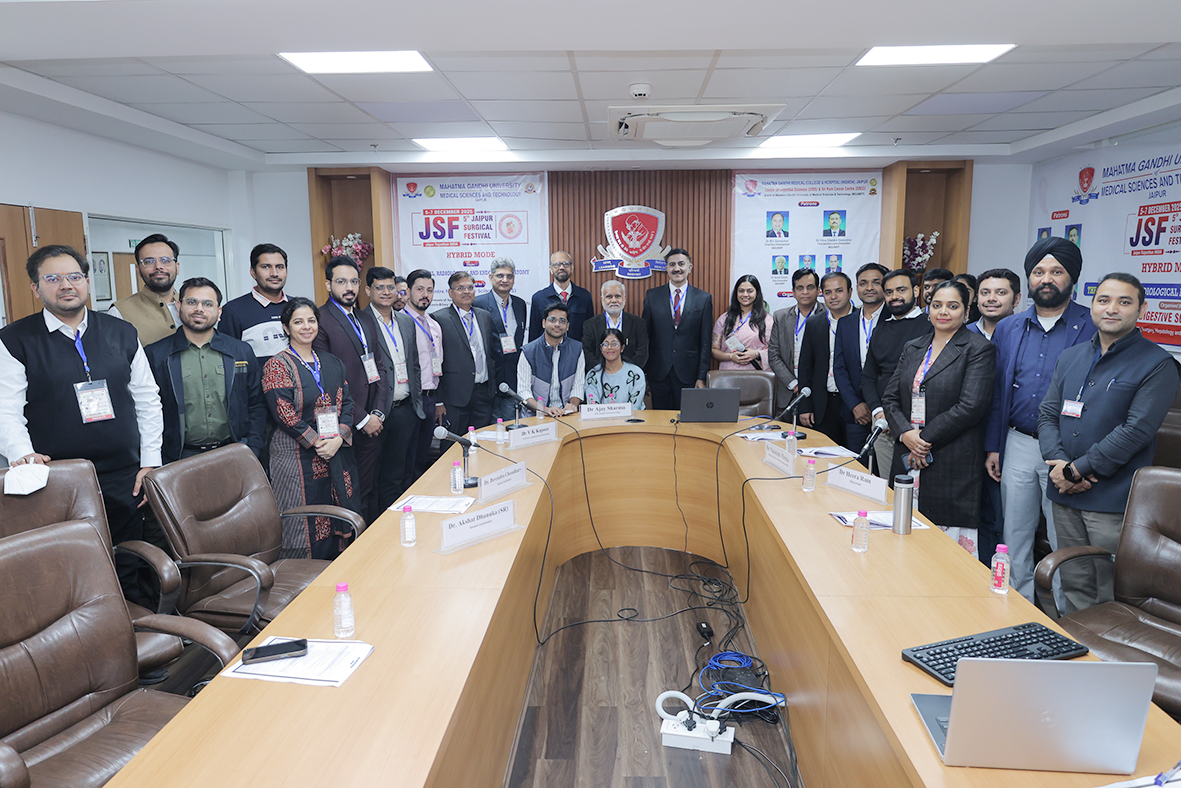
In the valedictory session, VK Kapoor succinctly summarized the key academic highlights of the three-day JSF. As the participants gathered for the concluding photograph (fig. 2), a shared realization emerged - that the learning curve in surgery has no plateau. 5th JSF 2025 stood as a powerful reminder that mastery in surgery begins, evolves, and ultimately rests in a profound respect for anatomy.
Figure 2 - Some of the faculty of the 5th Jaipur Surgical Festival (JSF) 2025
Conclusion
The Jaipur Surgical Festival (JSF) has become virtually synonymous with high-quality dissemination of surgical knowledge. All sessions of 5th JSF 2025 were live-streamed with high-quality audio and video and later uploaded on YouTube channels of MGUMST, Gastro University and Medflix, garnering over 1,000 views on the very first day. All videos remain accessible to anyone and everyone all the time online, ensuring continued learning beyond the conference location and time.
https://m.youtube.com/@MGUMSTJAIPUR/videos
https://m.youtube.com/@gastrouniversity6742/streams
https://medflix.app/
Full Text Sources:

Abstract:

Views: 234


For Authors
Journal Subscriptions

Jun 2026
Supplements
Instructions for authors
Online submission
Contact
e-ISSN: 2601 - 1700 (online)
ISSN-L: 2559 - 723X
Journal Abbreviation: Surg. Gastroenterol. Oncol.
Surgery, Gastroenterology and Oncology (SGO) is indexed in:
- SCOPUS
- EBSCO
- DOI/Crossref
- Google Scholar
- SCImago
- Harvard Library
- Open Academic Journals Index (OAJI)
Surgery, Gastroenterology and Oncology (SGO) is an open-access, peer-reviewed online journal published by Celsius Publishing House. The journal allows readers to read, download, copy, distribute, print, search, or link to the full text of its articles.
Time to first editorial decision: 25 days
Rejection rate: 61%
CiteScore: 0.2
 IASGO Society News
Meetings and Courses in 2025
Meetings and Courses in 2024
Meetings and Courses in 2023
Meetings and Courses in 2022
Meetings and Courses in 2021
Meetings and Courses in 2020
Meetings and Courses in 2019
Verona expert meeting 2019

Surgery, Gastroenterology and Oncology applies the Creative Commons Attribution Non Commercial (CC BY-NC 4.0) license, which permits readers to copy and redistribute the material in any medium or format, remix, adapt, build upon the published works non-commercially, and license the derivative works on different terms, provided the original material is properly cited and the use is non-commercial. Please see: https://creativecommons.org/licenses/by-nc/4.0/
Publisher’s Note:
The opinions, statements, and data contained in article are solely those of the authors and not of Surgery, Gastroenterology and Oncology journal or the editors. Publisher and the editors disclaim responsibility for any damage resulting from any ideas, instructions, methods, or products referred to in the content.