Surgery, Gastroenterology and Oncology

|
|
Background: Hemorrhoidectomy is the standard treatment for high grades of hemorrhoids, but is often associated with severe postoperative pain due to internal anal sphincter (IAS) spasm. This study evaluates the effect of partial lateral internal sphincterotomy (PLIS) on the outcomes.
Methods: One hundred patients with grade II-IV hemorrhoids were randomly allocated into two groups: Group A underwent conventional hemorrhoidectomy alone (n=50), and Group B underwent hemorrhoidectomy with PLIS (n=50). Patients were followed for 6 weeks postoperatively.
Results: The mean age was 41.65±8.7 years in Group A and 41.5±9.2 years in Group B (p=0.93). Postoperative pain was significantly lower in Group B (30%) compared to Group A (74%) (p<0.001). Mean hospital stay was shorter in Group B (1.5±0.5 days) versus Group A (1.9±0.7 days) (p=0.001). Wound healing was significantly faster in Group B (29.6±2.65 days) compared to Group A (44.9±3.5 days) (p<0.001). Postoperative bleeding occurred in 4% of Group A and 8% of Group B (p=0.68). Anal stenosis occurred in 2% of Group A with no cases in Group B (p=1.00). No significant difference was noted in infection rates (10% vs 16%, p=0.37). No incontinence was reported in either group.
Conclusion: PLIS combined with hemorrhoidectomy significantly reduces postoperative pain, shortens hospital stay, and enhances wound healing without increasing major complications.
Keywords: hemorrhoidectomy, lateral internal sphincterotomy, postoperative pain, wound healing
INTRODUCTION
Hemorrhoids, which afflict 4.4% to 36.4% of the general population, are dilated submucosal vascular anal cushions that are typically found in the anal canal at the 3, 7, and 11 o’clock positions (1). The peak incidence occurs in individuals aged 45-65 years (2). For grade III and IV hemorrhoids, conventional hemorrhoidectomy is still the preferred surgical procedure (3).
The main drawback of hemorrhoidectomy is excruciating pain during the first week following the procedure. This pain is caused by internal anal sphincter (IAS) spasm, which is revealed following an open hemorrhoidectomy, especially in younger patients with higher anal tone (4).
Partial lateral internal sphincterotomy (PLIS) reduces anal pressure, lessens IAS spasm, and interrupts the pain-spasm cycle responsible for postoperative pain, while also promoting wound healing (5).
This randomized controlled trial was designed to evaluate the effectiveness of PLIS on postoperative pain, healing, and complications, compared with hemorrhoidectomy alone.
PATIENTS AND METHODS
Study Design and Setting
From December 2023 to December 2024, the General Surgery Department of Assiut University Hospital hosted this prospective randomized controlled trial. The study was approved by the Clinical Research Ethics Committee and the Medical Research Ethics Committee, Faculty of Medicine, Assiut University. Written informed consent was obtained from every participant.
Patient Selection
Inclusion criteria were: surgically fit patients according to ASA classification, hemorrhoids grade II-IV, and age 18-60 years. Exclusion criteria were: surgically unfit patients, grade I hemorrhoids, secondary hemorrhoids, anal incontinence, and debilitating disease or immunosuppression.
Sample Size and Randomization
The randomization sequence was generated using computer-generated random number tables by a
statistician who was not involved in patient recruitment or outcome assessment. Allocation concealment was maintained using opaque sealed envelopes, which were opened by an independent nurse immediately before surgery to ensure that group allocation could not be anticipated in advance.
Group A (n=50) underwent conventional hemorrhoidectomy alone, while Group B (n=50) underwent hemorrhoidectomy with PLIS. All patients were blinded to group allocation.
Surgical Technique
All patients received standard preoperative preparation including two enemas, 6-hour fasting, prophylactic antibiotics (2g IV third-generation cephalosporin and 500mg metronidazole), and bladder emptying.
Group A underwent conventional Milligan-Morgan hemorrhoidectomy, with dissection using electrocautery and transfixation ligation of the pedicle, preserving skin bridges.
Group B underwent standard hemorrhoidectomy plus PLIS, performed during dissection of the pile at the 3 o’clock position, using dissecting scissors to create a snip in the lower IAS not exceeding 0.5 cm in depth.
Postoperative Assessment
Patients were followed for 6 weeks. Pain was assessed using the Visual Analogue Scale (VAS) at 24 hours and on postoperative days 3 and 7, and again at the 2-week and 6-week follow-up visits, and was classified as mild (1-3), moderate (4-7), or severe (>7) based on the highest recorded score during follow-up. Analgesic requirement, including the number and type of analgesic doses (including opioids), was recorded for each patient as an additional indicator of pain severity. Other outcomes included bleeding, infection, anal stenosis, incontinence, hospital stay, and wound healing time. The follow-up period extended to 8 weeks for patients who did not have complete wound healing or had other complaints.
Statistical Analysis
Statistical analysis was performed using SPSS software, version 26 (IBM Corp., Armonk, NY, USA). Continuous variables were expressed as mean ± standard deviation and compared between the two groups using the independent samples t-test. Categorical variables were expressed as numbers and percentages and compared using the chi-square test or Fisher’s exact test, as appropriate. A p-value of less than 0.05 was considered statistically significant.
RESULTS
One hundred patients were enrolled, with 50 patients in each group. The demographic and clinical characteristics were comparable between groups (tables 1-3).
Table 1 - Demographic data of studied patients

Table 2 - Medical history of studied patients

Table 3 - Clinical presentation of studied patients

Postoperative Outcomes
Moderate to severe postoperative pain was significantly lower in Group B (30%) compared with Group A (74%) (p<0.001). In Group A, 34% of patients reported severe pain requiring more than three doses of opioids, compared with 14% in Group B (table 4).
Table 4 - Postoperative outcomes of studied patients
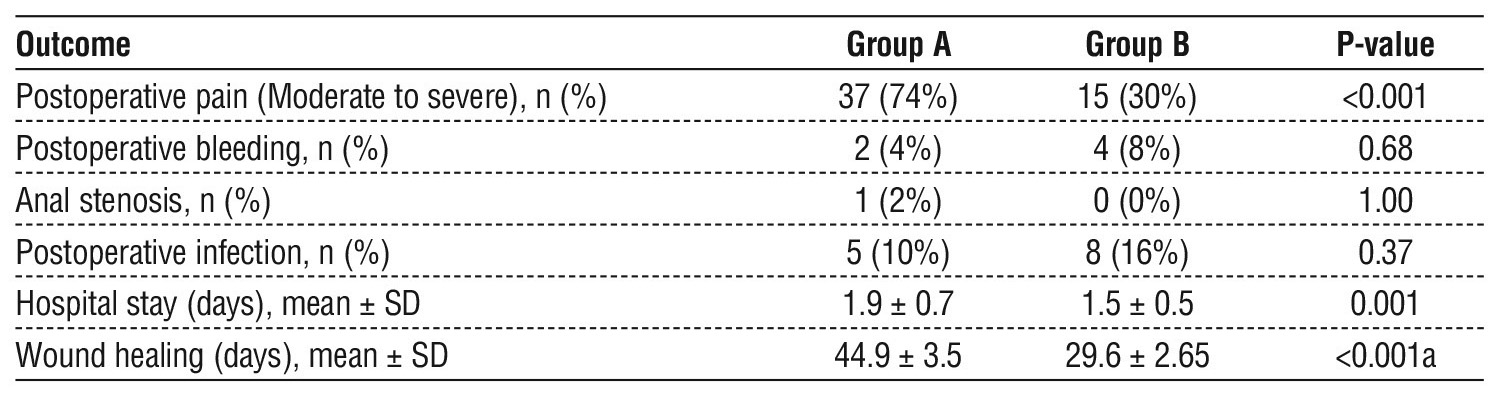
Postoperative bleeding occurred in 2 patients (4%) in Group A (both secondary bleeding) and in 4 patients (8%) in Group B (2 primary, 2 secondary), with no significant difference between groups (p=0.68). All bleeding episodes were mild and managed conservatively.
One patient (2%) in Group A developed anal stenosis at 5 weeks, which responded to Hegar dilator dilatation. No cases of anal stenosis occurred in Group B (p=1.00).
Postoperative infection occurred in 5 patients (10%) in Group A and 8 patients (16%) in Group B (p=0.37). All infections were mild to moderate and were managed conservatively.
Mean hospital stay was significantly shorter in Group B (1.5±0.5 days) compared with Group A (1.9±0.7 days) (p=0.001), primarily due to reduced analgesic requirements.
Wound healing was significantly faster in Group B (29.6±2.65 days) compared with Group A (44.9 ± 3.5 days) (p<0.001). No anal incontinence was reported in either group during follow-up.
DISCUSSION
TThis randomized controlled trial suggests that the addition of PLIS to conventional hemorrhoidectomy may improve postoperative outcomes, particularly in terms of pain reduction, shorter hospital stay, and faster wound healing.
The most important finding in this study is the significant reduction in moderate to severe post-operative pain in the PLIS group (30% vs 74%, p<0.001). This may be explained by the reduction in IAS tone, which helps to break the pain-spasm cycle commonly observed after hemorrhoidectomy. Similar findings have been reported in previous studies, such as those by Yaqoup et al., Al-Gadaa, and Memon et al., who demonstrated lower pain scores in patients undergoing combined procedures (6-8).
However, Khubchandani found no statistically significant difference in postoperative pain following the addition of a sphincterotomy, which runs counter to our findings (9).
The shorter hospital stay observed in the PLIS group (1.5±0.5 vs 1.9±0.7 days, p=0.001) is likely a direct consequence of reduced postoperative pain and decreased need for strong analgesics. This finding is consistent with studies by Galizia et al. and Yadaw et al., which also reported earlier discharge in patients undergoing sphincterotomy (10,11).
Yadaw et al. demonstrated decreased postoperative pain, enhanced quality of life, and shorter hospital stays. Furthermore, the addition of lateral internal sphincterotomy only slightly increased the overall surgical time (11).
Wound healing was significantly faster in the PLIS group (29.6±2.65 vs 44.9±3.5 days, p<0.001), which may be attributed to improved anodermic blood flow following reduction of sphincter pressure. This supports the physiological role of sphincterotomy in enhancing tissue perfusion and promoting healing.
Meenakshi et al. also reported that hemorrhoidectomy combined with PLIS facilitates more rapid wound healing and enhances patient recovery (12).
Regarding complications, no statistically significant differences were observed between the two groups in terms of bleeding and infection. Although bleeding was slightly more frequent in the PLIS group, all cases were mild and managed conservatively. Interestingly, anal stenosis occurred only in one case (2%) in the hemorrhoidectomy-only group, with no cases in the PLIS group, suggesting that reducing sphincter spasm may have a protective effect against stenosis. This is consistent with Galizia et al., who reported postoperative anal stenosis requiring early dilation in 4 patients (18.1%) in the hemorrhoidectomy-only group, with no cases in the PLIS group (10).
Importantly, no cases of anal incontinence were reported in this study. This may be attributed to the limited extent of sphincterotomy (≤0.5 cm) and careful surgical technique. This finding differs from some studies reporting transient incontinence, mainly to flatus (ranging from 4.7% to 17%), which may be related to more extensive sphincter division (10,13,14).
This study has certain limitations. First, the follow-up period was limited to 6 weeks, which may not be sufficient to detect late complications such as recurrence or delayed onset incontinence; longer-term follow-up is recommended in future studies. Second, this was a single-center study with a relatively modest sample size, which may limit the generalizability of these findings and reduce the power to detect differences in less common complications such as bleeding and infection. Third, objective functional assessment of the internal anal sphincter using ano-rectal manometry was not performed; reliance on clinical assessment and the VAS-based pain scale alone may not fully capture changes in sphincter function before and after surgery. Future multicenter studies with longer follow-up and pre and postoperative anorectal manometry are recommended to confirm and extend these findings.
CONCLUSION
In this study, combining PLIS with conventional hemorrhoidectomy was associated with a significant reduction in postoperative pain and faster wound healing, without an increase in major complications, suggesting that it is a safe and feasible adjunct to conventional hemorrhoidectomy. The short follow-up duration and small sample size restrict the statistical power of the analysis. These limitations prevent definitive conclusions about late-onset or rare adverse events, specifically the incidence and severity of long-term anal incontinence. Future studies require extended observation periods and larger, multicenter cohorts to properly assess these risks.
Conflicts of Interest
The authors declare that there is no conflict of interest.
Financial Disclosures: none
Clinical trial registration: NCT06588374
REFERENCES
1. Guraya SY, Khairy GA. Stapled hemorrhoidectomy: results of a prospective clinical trial in Saudi Arabia. J Clin Diagn Res. 2013; 7(9):1949-52.
2. Kaidar-Person O, Person B, Wexner SD. Hemorrhoidal disease: a comprehensive review. J Am Coll Surg. 2007;204(1):102-117.
3. Hosseini SV, Sharifi K, Ahmadfard A, Mosallaei M, Pourahmad S, Bolandparvaz S. Role of internal sphincterotomy in the treatment of hemorrhoids: a randomized clinical trial. Arch Iran Med. 2007;10(4): 504-508.
4. Asfar SK, Juma TH, Ala-Edeen T. Hemorrhoidectomy and sphincterotomy. A prospective study comparing the effectiveness of anal stretch and sphincterotomy in reducing pain after hemorrhoidectomy. Dis Colon Rectum. 1988;31(3):181-5.
5. Patti R, Almasio PL, Muggeo VMR, Buscemi S, Arcara M, Matranga S, et al. Improvement of wound healing after hemorrhoidectomy: a double-blind, randomized study of botulinum toxin injection. Dis Colon Rectum. 2005; 48(12):2173-9.
6. Yaqoup HA, Muslim SK, Al-Kayat SH. The effect of lateral internal sphincterotomy on postoperative pain following open hemorrhoidectomy. NeuroQuantology. 2021;19(8):1-6.
7. Memon AI, Kumar H, Behan RB, Bhatti AM. Comparative study of open hemorrhoidectomy with or without lateral internal sphincterotomy. J Liaquat Univ Med Health Sci. 2022;21(1):1-6.
8. Al-Gadaa AH. Extent of influence of lateral internal sphincterotomy for alleviation of post-hemorrhoidectomy pain. Int J Surg Res. 2025; 7(2):22-25.
9. Khubchandani IT. Internal sphincterotomy with hemorrhoidectomy does not relieve pain: a prospective, randomized study. Dis Colon Rectum. 2002;45:1452-1457.
10. Galizia G, Lieto E, Castellano P, Pelosio L, Imperatore V, Pignatelli C. Lateral internal sphincterotomy together with haemorrhoidectomy for treatment of haemorrhoids: a randomized prospective study. Eur J Surg. 2000;166:223-228.
11. Yadaw V, Kumar S, Hassan F, Kumar A, Mishra DI, Kumar S. Lateral internal sphincterotomy as a pain-relief adjunct in open hemorrhoidectomy: a comparative analysis. Int J Acad Med Pharm. 2024;6(6):230-233.
12. Meenakshi A, Shashikala V. A prospective comparative study of hemorrhoidectomy without lateral sphincterotomy and hemorrhoidectomy with lateral sphincterotomy. Int J Sci Acad Res. 2026;7(1):75-78.
13. Wang WG, Lu WZ, Yang CM, Yu KQ, He HB. Effect of lateral internal sphincterotomy in patients undergoing excisional hemorrhoidectomy. Medicine (Baltimore). 2018;97(32):e11820.
14. Abdraboh OH, Saber SA, Mousa G, Eissa MA. Does routine partial lateral sphincterotomy with open hemorrhoidectomy improve postoperative pain?. The Egyptian Journal of Surgery. 2024;43(1):1-8.
Full Text Sources:

Abstract:

Views: 232


For Authors
Journal Subscriptions

Jun 2026
Supplements
Instructions for authors
Online submission
Contact
e-ISSN: 2601 - 1700 (online)
ISSN-L: 2559 - 723X
Journal Abbreviation: Surg. Gastroenterol. Oncol.
Surgery, Gastroenterology and Oncology (SGO) is indexed in:
- SCOPUS
- EBSCO
- DOI/Crossref
- Google Scholar
- SCImago
- Harvard Library
- Open Academic Journals Index (OAJI)
Surgery, Gastroenterology and Oncology (SGO) is an open-access, peer-reviewed online journal published by Celsius Publishing House. The journal allows readers to read, download, copy, distribute, print, search, or link to the full text of its articles.
Time to first editorial decision: 25 days
Rejection rate: 61%
CiteScore: 0.2
 IASGO Society News
Meetings and Courses in 2025
Meetings and Courses in 2024
Meetings and Courses in 2023
Meetings and Courses in 2022
Meetings and Courses in 2021
Meetings and Courses in 2020
Meetings and Courses in 2019
Verona expert meeting 2019

Surgery, Gastroenterology and Oncology applies the Creative Commons Attribution Non Commercial (CC BY-NC 4.0) license, which permits readers to copy and redistribute the material in any medium or format, remix, adapt, build upon the published works non-commercially, and license the derivative works on different terms, provided the original material is properly cited and the use is non-commercial. Please see: https://creativecommons.org/licenses/by-nc/4.0/
Publisher’s Note:
The opinions, statements, and data contained in article are solely those of the authors and not of Surgery, Gastroenterology and Oncology journal or the editors. Publisher and the editors disclaim responsibility for any damage resulting from any ideas, instructions, methods, or products referred to in the content.